
Bol listing optimisation: from visibility to sales
Many Bol sellers do get traffic to their listings, but see too few click-throughs to a purchase. That is usually not an advertising problem, but a listing problem. The product page then does not answer quickly enough the questions a buyer has in the first few seconds.
At BrandMonks we see that strong listings do not come from loose tweaks, but from a fixed structure that combines relevance, trust and persuasion. The goal is not just to be more visible, but above all more quality sales with less return friction.
On this page we zoom in fully on listing optimisation on Bol: title, bullets, description, image order, templates and iteration. For broader channel strategy, you can continue to marketplace performance. For ranking mechanics at platform level, go to bol ranking factors.
We have written this as a hands-on article: what exactly should you change, how do you test improvements and how do you make this scalable for variants and product ranges without losing quality?
Why many listings do not convert, even with good reach
A listing often fails on three points at once. One: the title is technically filled but not persuasively prioritised. Two: the bullets name features, but do not translate them into customer benefits. Three: the images show the product, but do not remove doubt.
What we often see in practice: sellers optimise per element, but without a central logic. You then get a reasonable title, reasonable images and reasonable copy, but not a strong product page. The visitor senses that fragmentation immediately. The result: lower conversion and more often the wrong expectation.
A good listing works as one story with a clear order. First attention and relevance, then trust and proof, after that a faster choice. As soon as you guard that order, the commercial quality of the page often rises faster than with loose adjustments.
That is why at BrandMonks we advise judging every listing on coherence rather than on individual parts. From that basis you can accelerate in a targeted way on increasing marketplace conversion instead of optimising ad hoc.
Title optimisation: relevance and clicks in one line
The title determines whether your listing makes it into the first scanning round. Many titles do contain search terms, but lack priority. The most important intent then comes too late or drowns between details.
Work with a fixed title formula
A practical formula that works in many categories: product type + main distinguishing feature + relevant variant information. That covers both findability and quick understanding.
Common title mistakes
- too many features without hierarchy;
- repeating the same word;
- vague marketing language without a concrete benefit;
- important variant information only at the end.
| Element | Weak title | Strong title |
|---|---|---|
| Structure | loose words without order | intent first, distinction right after |
| Clarity | technical but unclear | concrete and scannable on mobile |
| Relevance | keyword overload | targeted terms with clear context |
Bullet points that sell: from feature to outcome
Bullet points have to answer the question: why is this product the right choice for me? Many bullets get stuck in specs and skip the translation into practical value.
We use a simple framework per bullet for this: benefit, proof, application. The benefit makes the promise clear, the proof increases credibility and the application helps the buyer picture themselves with the product.
How to build strong bullets
Bullet 1: core benefit
What does the product deliver directly for the user?
Bullet 2: practical use
In which situation does this product demonstrably work well?
Bullet 3: differentiation
Why is this model better than a common alternative?
Bullet 4: trust
Which doubt can you remove straight away with factual information?
This structure works especially well when you combine it with consistent visual support. That is why we often link bullet optimisation to content design and product images (3D, AI and image editing).
Description and product specifications: preventing doubt before the customer drops off
The product description is not filler text. This is where you catch objections and set sharp expectations. A weak description not only increases drop-offs, but often returns too.
A good description does three things. It clarifies who the product is for. It makes use and limits clear. And it confirms why this product is the logical choice within the category.
What is often missing is negative clarity: what is this product not? It is exactly that clarity that reduces mismatches. If you only name benefits and skip the limitations, the pressure of returns usually grows faster.
So do not just write sales copy, write decision copy. Help the buyer choose better. That increases conversion on the right orders and protects your margin in the longer term.
Image order and main image: the biggest conversion lever on mobile
In many categories the first selection is made visually. The main image determines whether someone clicks, the following images determine whether someone builds trust.
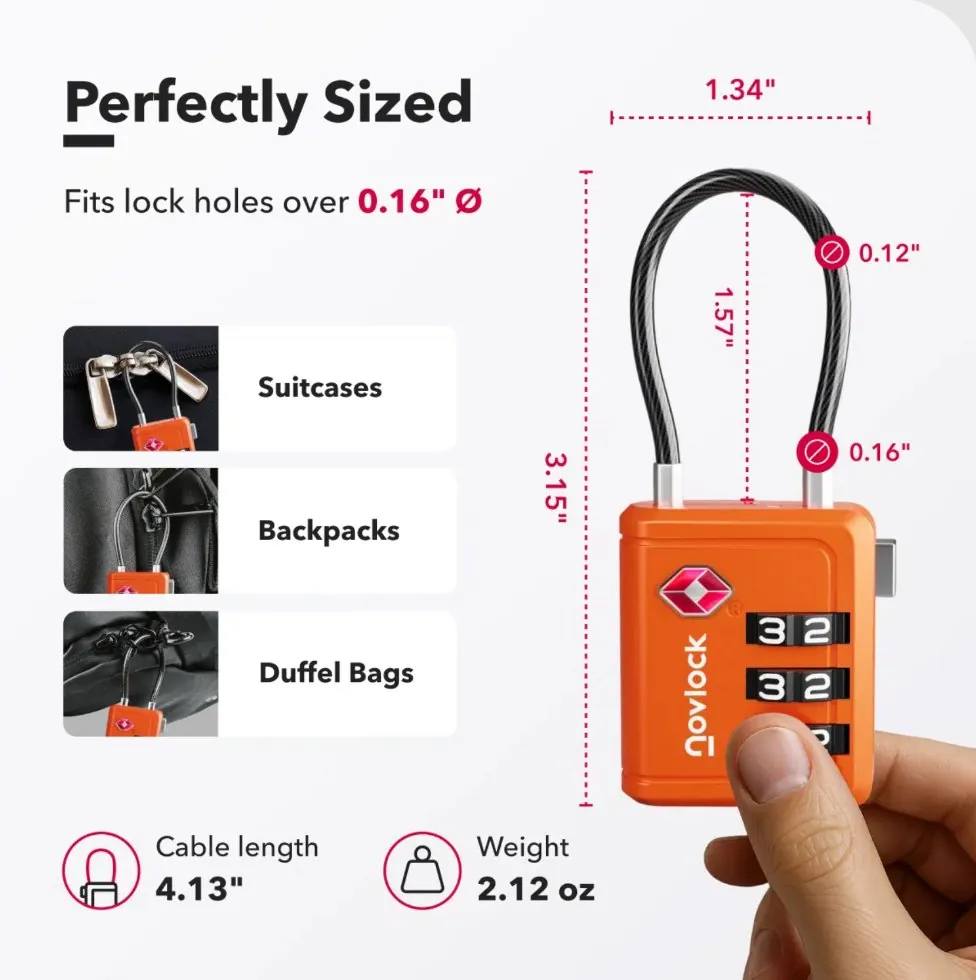
Many listings have perfectly good images, but no order. The page then lacks rhythm. You see the product, but do not understand quickly enough why it is a good choice. That is why we work with a fixed visual sequence: main image, context, detail, proof, comparison.
Indicative impact on listing results
- Title and relevance
- Bullet and description quality
- Image order and visual clarity
- Other listing factors
Indicative breakdown. Actual impact varies by category and competitive pressure.
Scalable listing design with Figma templates and components
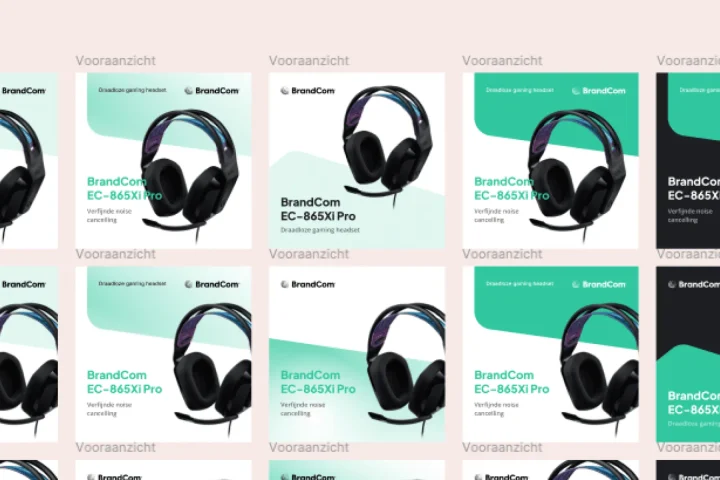
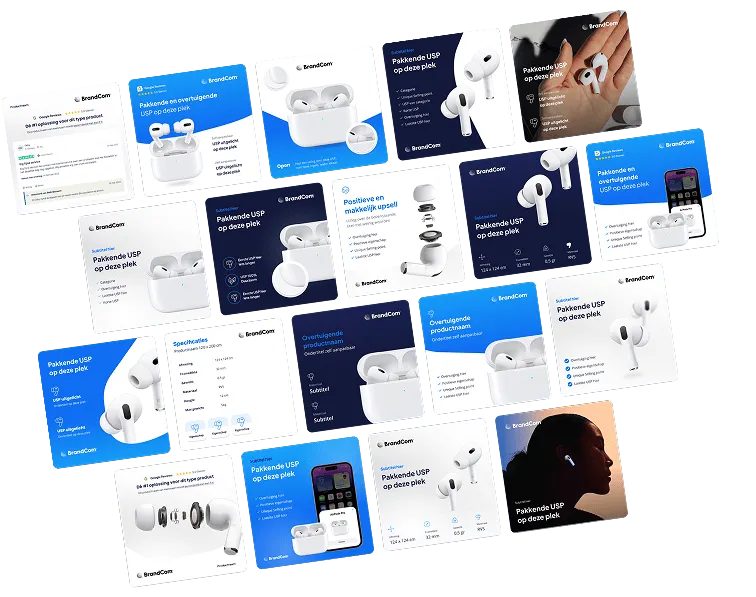
This is an important distinction for BrandMonks. We do not design listings as loose one-off visuals, but as a scalable system in Figma. That means: components, styles, fixed content blocks and variant logic that you can roll out across product ranges.
For clients with many SKUs this makes a big difference. Without a component approach you have to design again per listing, with a high risk of inconsistency. With components you work faster, more consistently and with fewer rounds of revisions.
What this delivers in practice
- faster production of variants within the same product line;
- consistent brand language across several listings;
- a lower chance of errors in claims, visuals and order of information;
- easier updates when the market or product changes.
This way of working ties in directly with your goal of scale: not just attractive listings, but repeatable listing quality at range level.
From loose listing adjustments to a production process that keeps working
Many teams optimise when a problem arises. That is reactive. For sustainable growth you need a fixed rhythm in which design, copy and performance come together.
We advise a simple cadence with fixed checkpoints. Every week you review the core KPIs per listing group. Every two weeks you make targeted adjustments to title, bullets and visual order. Every month you assess whether the improvements also carry through to returns behaviour and pressure on margins.
What matters is that every listing block has an owner. Without ownership, improvements often get stuck in discussions. With ownership you can decide faster and learn faster.
If you set up this process, you prevent optimisation from becoming a separate project. It then becomes part of your operational basis and forms a strong bridge to broader conversion optimisation on marketplaces.
30-60-90 listing sprint: a concrete route to better performance
A listing sprint helps you carry out improvements in the right order. Not everything at once, but everything with clear priority.
Days 1 to 30: foundation
Take a baseline measurement of CTR, conversion, returns signals and listing quality. Select the top SKUs where improvement has the most effect.
Days 31 to 60: optimisation
Rebuild titles, bullets and key images based on fixed templates. Test in a targeted way per listing group instead of making random loose edits.
Days 61 to 90: scaling up
Roll out proven structures to variants and product ranges. Secure components in your Figma library so that new listings start at the same level of quality.
This approach makes growth more predictable. You then steer on decision rules instead of loose opinions.
Common mistakes in Bol listing optimisation
Mistake 1: writing for keywords without buying logic
Findability without persuasion brings in traffic, but too few sales.
Mistake 2: visually strong, but too vague in content
Attractive images without clear claims and context increase doubt.
Mistake 3: too many unique designs, too little system
Without templates/components, production becomes slow and inconsistent.
Mistake 4: no testing rhythm
Without fixed measurement windows, you do not know which adjustment has an effect.
Mistake 5: treating listing and performance separately
If copy, images and KPI management are not linked, improvement stays fragmented.
By avoiding these mistakes, you build a listing process that works not only today, but also as your range and team grow.
Frequently asked questions about Bol listing optimisation
What does Bol listing optimisation usually deliver?
In practice you often see an improvement in click-through rate, conversion and quality of orders. The exact effect varies by category and competitive pressure.
How soon can you expect results?
On key listings you often see movement within a few weeks, provided you work with clear hypotheses and measurement windows.
When is outsourcing a smart move?
When you lack the internal capacity to keep copy, images and iterations up to standard on a structural basis. Outsourcing is then often faster and more economical.
Does a template approach also work for different product types?
Yes, as long as you work with flexible components and fixed decision rules per category.
How does this relate to ranking on Bol?
Listing quality influences conversion signals and therefore, indirectly, your position. To go deeper: bol ranking factors.
Conclusion: strong Bol listings are not loose creatives, but a scalable system
Bol listing optimisation works best when you approach it as a system: a clear title structure, persuasive bullets, a description that reduces doubt, a strong image order and a fixed iteration process.
At BrandMonks we link that content layer to a scalable design approach in Figma with templates and components. That lets us develop listings quickly and consistently for variants and product ranges, without compromising on quality.
That makes the difference between improving now and then and scaling up sustainably. Not one good listing, but a production approach that keeps performing across the board.
Want to translate this to your range? Then we are happy to start with an introductory call. After that we determine which listings are the biggest lever and how we turn them, step by step, into measurably better performance.
Relevant follow-up pages:

Melle Sikma
Helmsman
melle@brandmonks.nl