

Bol ranking factors in 2026: what really determines your position
Ranking on Bol is often reduced to price and keywords. In practice, a combination of relevance, conversion and operational reliability determines how steadily you stay at the top.
At BrandMonks we see that many accounts do not lose out on potential, but on inconsistency. A few weak signals are enough to gradually give away your position.
In this article we focus entirely on bol ranking factors: what they are, how to prioritise them and which actions have the quickest effect. For the broader framework, see marketplace performance. For more depth on listing copy and visual structure, go to bol listing optimisation.
How ranking on Bol works: four signal layers
Your ranking position is the sum of signals. If you only turn a single knob, you often see a short-term gain but no stability.
Layer 1: relevance
Title, features, attributes and categorisation must match the search intent logically. If this foundation is off, visibility becomes fragile.
Layer 2: conversion signals
Bol sees how users respond to your listing. A strong click-through rate and conversion support your position. Weak interaction holds back further growth.
Layer 3: operational quality
Delivery time, cancellations, return patterns and service performance feed directly into reliability.
Layer 4: commercial consistency
Price, availability and execution discipline must line up. A sharp price without stable execution rarely wins for long.
The Buy Box on Bol: practical factors and decision rules
For many sellers the Buy Box is the most important revenue lever. Yet the battle for it is often fought too narrowly. Simply undercutting seems logical, but is rarely the healthiest route.
The Buy Box is influenced by more than price. Availability, delivery performance and customer trust count in practice. That means a slightly higher price can still win when the rest of the signals are stronger.
So see the Buy Box as the outcome of overall execution quality. A price promotion without an improvement in reliability or listing quality is usually short-lived. Teams that build this into their decision rules in advance protect their margin better in the long run.
Timing matters too. Ranking and the Buy Box do not always respond immediately to a change. If you draw conclusions too early, you often end up tinkering again for no reason. So work with fixed observation windows per type of intervention: short for technical corrections, longer for content or operational improvements.
Decision rules we recommend
- Only lower your price when your underlying listing and service quality are up to standard.
- Set margin thresholds in advance, so you do not make decisions under pressure.
- Link price promotions to a clear evaluation moment.
- Stop following the market if the Buy Box is only achievable below your net floor.
For teams that want to steer the effect of price on conversion more broadly, increasing marketplace conversion is a logical next step.
Improving relevance: title, categorisation and attributes
A lot of ranking loss starts in the relevance layer. Not through completely wrong content, but through subtle mismatches between search intent and listing structure.
The most common mistakes:
- the core search intent appears too late in the title;
- attributes are incomplete or inconsistent;
- the chosen category does not match the moment of use well;
- variants are technically correct, but presented in a commercially illogical way.
So work with a fixed relevance check per important listing group. Start with intent, then check categorisation and finish with field consistency. This order stops you treating symptoms in the wrong layer.
Relevance check in 10 minutes
Start with the search term your listing currently gets most impressions for. Then check whether that term actually appears in the title priority, the features and the chosen category. Next, look at the variants: do they strengthen the choice, or do they make the page messier? This quick check often reveals fast whether your ranking loss is a content problem or a structural problem.
Conversion signals as a ranking engine
Visibility without selling power does not last. That is why ranking management is always linked to conversion.
If your CTR drops while the price stays the same, the first impression has usually got worse. If CTR is stable but conversion drops, the friction is often at product page level. Once you make this distinction, you can adjust faster and more precisely.
An effective routine is to assess three points per top SKU every month: first impression, structure of the argument, and expectation versus reality. For the full details of that listing layer, use bol listing optimisation.
Operational signals: reliability wins in the long run
Many sellers underestimate how quickly operational noise damages their ranking. A series of small mistakes can hit your position just as hard as a weak listing.
Key points to monitor closely:
- delivery reliability;
- cancellations;
- return trend and return reason;
- response speed to customer questions.
As soon as one of these signals gets structurally worse, your commercial room to manoeuvre shrinks. That is why ranking management should not sit with marketing alone, but must also be anchored operationally in the team and the process.
Turn this into a monthly root cause analysis. Not just how many returns or cancellations you have, but which recurring causes are behind them. You then translate those causes into concrete changes to the listing, logistics or service logic.
On top of that, set service SLAs per product group. A standard support response within 24 hours or a fixed approach to recurring delivery problems sounds basic, but it stops operational noise from slowly undermining your ranking. Over time, structural reliability is rewarded more often than occasional price aggression.
Prioritising when rankings drop: what to do in the first 48 hours
When ranking collapses, speed matters. But speed without order often leads to the wrong actions.
Step 1: diagnosis by signal layer
First determine whether the problem is mainly relevance, conversion or operations.
Step 2: one targeted correction
Do not carry out a broad overhaul. Choose a single correction with the biggest expected effect.
Step 3: measurement window and decision
Keep a short evaluation window and decide in advance when you will scale up or roll back.
This approach prevents panic optimisation and builds a learning process you can reuse later.
Weekly and monthly measurement plan
Ranking becomes more stable with rhythm. Not because you do more, but because you make the right decisions at fixed moments.
Weekly
Check visibility, CTR, conversion and operational deviations for top SKUs.
Fortnightly
Targeted iterations on listings that have potential but perform below benchmark.
Monthly
Review product group decisions: accelerate, improve or phase out based on margin and stability.
Link every metric to an owner and a response time. Without ownership, ranking management stays too reactive.
Work with threshold values in your dashboard instead of loose observations. For example: CTR below your minimum for two consecutive weeks triggers a mandatory review of the title and main image. A return rate above the threshold triggers an immediate expectation check in the content and service flow. That makes ranking management controllable and predictable.
Quarterly review per product group
Once a quarter you assess per product group whether the current strategy still holds. Products with a stable margin and strong signals get a growth focus. Products with recurring friction go into an improvement cycle first. Products that stay structurally below the floor are phased out or repositioned. That keeps ranking work tied to commercial reality.
Improving at scale with templates and components
When your range grows, adjusting listing quality by hand becomes too slow. Then you need a scalable execution layer.
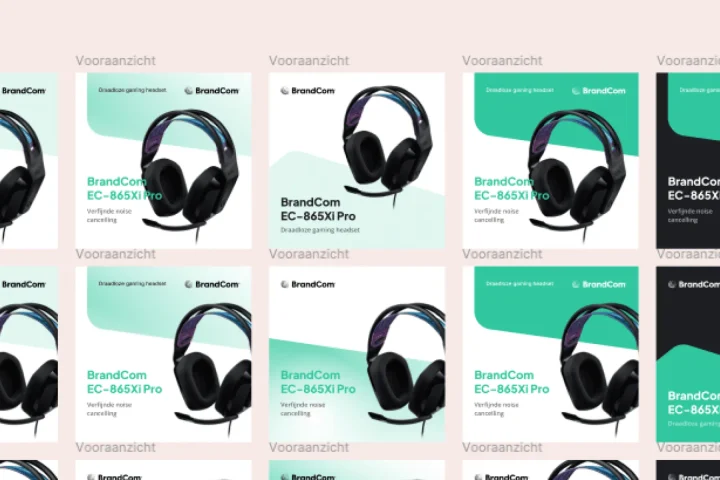
At BrandMonks we often use Figma components and template blocks for this. They keep your visual and content structure consistent across variants and product ranges, while iterations go faster.
This approach helps ranking indirectly in two ways. You reduce quality differences between listings and you shorten the time from signal to adjustment. For teams that want to build this out further, listing template design is a good fit.
Common mistakes with bol ranking
Mistake 1: treating ranking as a keyword game
Without conversion and performance quality, gains stay short-lived.
Mistake 2: price as the default solution
You lose margin and make your model dependent on undercutting.
Mistake 3: no distinction between signal layers
Without a diagnosis of relevance, conversion and operations, you are steering on symptoms.
Mistake 4: too many changes at once
Then cause and effect are unclear and you learn slowly.
Mistake 5: no fixed rhythm
Without a weekly and monthly cadence, you usually act too late.
An extra pitfall is that teams keep optimising for too long on products that structurally fall short. Without hard thresholds, ranking management quickly becomes an endless repair loop.
Another common problem is inconsistent terminology between teams. If marketing talks about “visibility”, operations about “service quality” and finance about “margin leakage”, everyone is discussing the same problem in different words. So create a shared ranking language with fixed definitions per signal. That speeds up decision-making and prevents delayed corrections.
Frequently asked questions about bol ranking factors
Is price the most important ranking factor on Bol?
Price matters, but it is not everything. Relevance, conversion and reliability carry a lot of weight.
How quickly can you see ranking recovery?
With targeted corrections you often see movement within a few weeks, depending on the category and competitive pressure.
What is the best first step when rankings drop?
First diagnose the layer, then make one targeted correction with a measurement window.
Should I treat ranking and conversion separately?
No, they belong in the same management approach. Ranking without conversion quality is usually unstable.
When does outsourcing make sense?
When you lack the internal capacity to combine data, execution and iteration structurally.
Which metric is the best early warning of ranking loss?
In many accounts it is a falling click-through rate while price and stock stay stable. That signal often comes earlier than a visible drop in revenue.
Conclusion: bol ranking factors call for discipline, not tricks
If you want to improve ranking for the long term, you need to steer consistently on four layers: relevance, conversion, operations and commercial discipline. That way you do not build a short peak, but a position that holds up better under competitive pressure.
At BrandMonks we translate this into a practical rhythm with clear decision rules, tight iterations and scalable execution. That lets you respond faster to drops and grow in a controlled way on listings with real potential.
Want to apply this to your account? Book an intake call. We will then determine which factors are weighing most on your ranking right now and which corrections should get priority.
Further reading:
- Marketplace performance
- Increasing marketplace conversion
- Bol listing optimisation
- Selling via Bol.com

Melle Sikma
Helmsman
melle@brandmonks.nl