
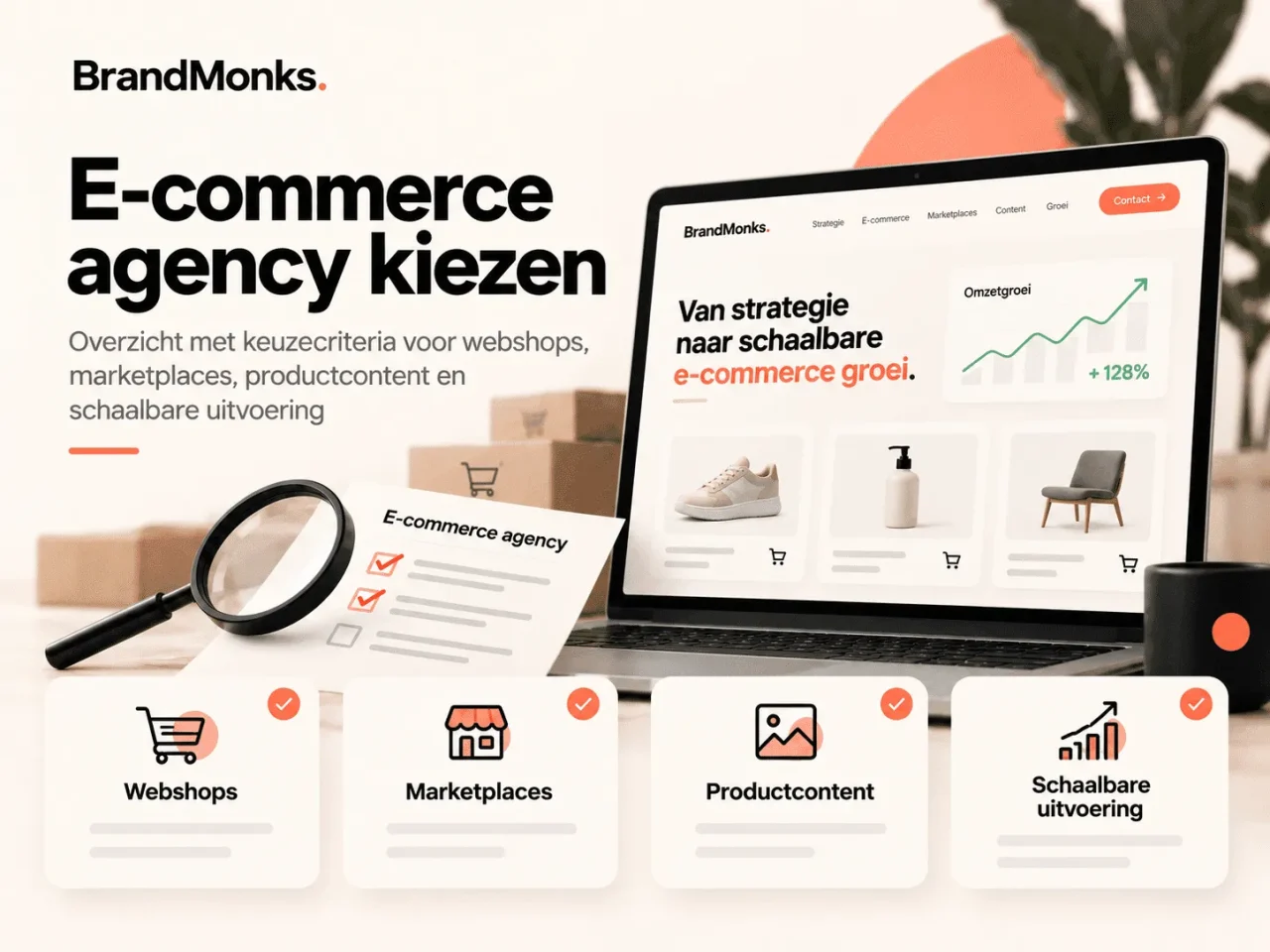
This checklist helps you compare agencies. Want to know how we go about it? Read more about BrandMonks as an e-commerce agency.
Do not choose an e-commerce agency on a nice portfolio alone
Choosing an e-commerce agency does not start with the best-looking cases, but with the question of what is holding your web shop back right now.
The best agency for your situation is the one that fits your growth question, your channel mix and the way your product content needs to grow with you.
That sounds logical, but in practice it often goes wrong. Many e-commerce entrepreneurs compare agencies on general promises: more revenue, better campaigns, a nicer web shop or full-service support. But that says little about what you actually need. A brand with thirty products and a strong web shop of its own needs a different partner from a seller with hundreds of SKUs on bol.com, Amazon and Kaufland.
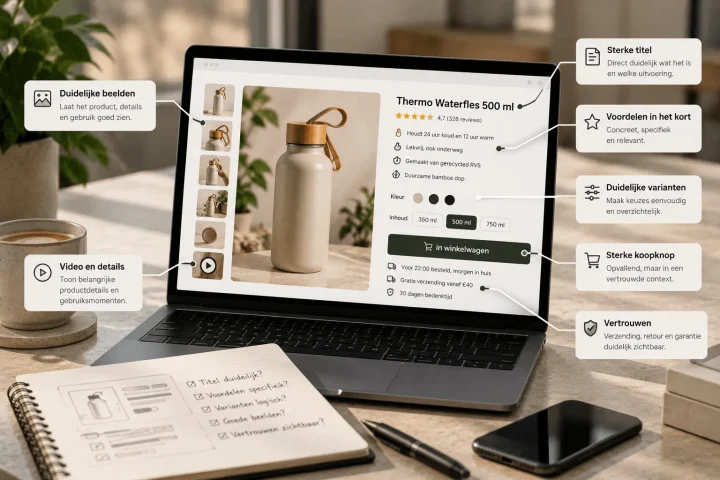
That is why choosing an e-commerce agency is mainly an exercise in focus. You are not looking for “the best e-commerce agency” in general. You are looking for a partner who can solve your specific growth blocker. Sometimes that blocker is technical. Sometimes it is in advertising. But often it sits much closer to the product page: unclear images, thin product information, inconsistent listings, little trust or a content process that is too slow to get new products live properly.
BrandMonks works mainly in that last layer. We help brands, web shops and marketplace sellers make their content, visuals and listings stronger at scale. Not as a one-off creative project, but as a system that publishes faster, looks more consistent and fits better with what customers need in order to buy.
Start with the problem you want to solve
Before you compare e-commerce agencies, first work out which problem is leaking the most revenue. Otherwise you can easily end up with an agency that sounds impressive but does not have the right lever.
A web shop that gets too little traffic may need SEO or advertising. A web shop that gets enough visitors but few orders probably needs clearer product pages, better visuals, stronger proof or less friction. A brand that wants to grow on marketplaces has different questions again: are the listings right, do the images match the channel requirements, are the titles and bullet points strong enough and can new content be rolled out fast enough?
So ask yourself these questions first:
- Where is growth visibly stalling right now?
- Is it mainly traffic, conversion, content quality, speed or channel expansion?
- Is it a one-off improvement or a recurring production workflow?
- Should the agency mainly advise, execute or set up a scalable system?
- Does your web shop need to get stronger, your marketplace presence, or the connection between the two?
This step stops you choosing an overly broad agency for a very concrete problem. A “full-service e-commerce agency” can be valuable, but only if that breadth really fits your situation. If you mainly need product content, listing images and channel consistency, a specialised e-commerce agency with strong visual execution is often more logical than an agency that is primarily about campaigns or technology.
Recognise the difference between types of e-commerce agencies
Anyone looking for an e-commerce agency quickly ends up on comparison pages, top lists and agency overviews. That is useful, but also confusing. Many parties use similar terms while doing different things in practice.
A web shop builder usually focuses on the technology, design and development of the web shop. A marketing agency more often looks at traffic, campaigns, SEO and email. A marketplace agency can help with channel set-up, optimisation and sometimes account management. A content or visual-first e-commerce agency looks at whether your product communication is strong enough to convince visitors and whether that communication can be rolled out at scale.
| Type of agency | Strong in | Less suitable if | Good fit for |
|---|---|---|---|
| Web shop builder | Technology, platform choice, checkout and front end | You mainly need to scale product content and listing visuals | A new web shop or a major migration |
| Marketing agency | Traffic, campaigns, SEO and email | The product page itself is not yet convincing enough | More reach and recurring campaigns |
| Marketplace agency | Channel optimisation, marketplace rules and account growth | Your brand image and product content do not yet have a solid foundation | Growth on bol.com, Amazon or other marketplaces |
| Content-first e-commerce agency | Product visuals, copy, listings, templates and content workflow | You mainly need complex back-end development | Brands that want to publish faster and more consistently |
Pay attention to product content if you have many products or channels
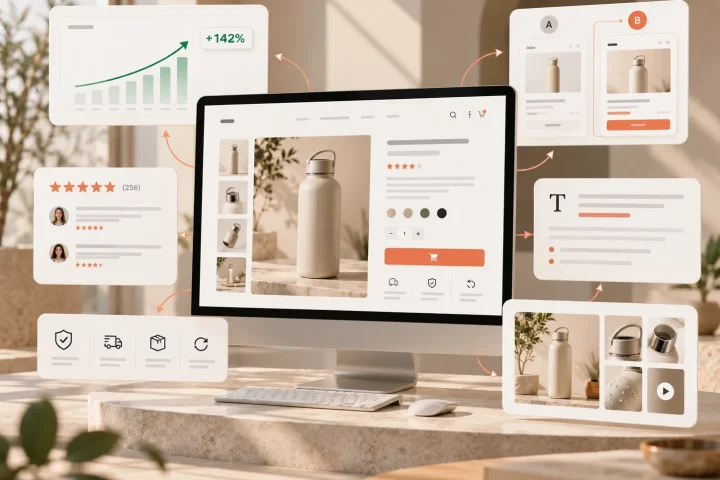
For e-commerce entrepreneurs with a larger range, product content is usually one of the biggest growth accelerators. Not because every text has to be perfectly literary, but because customers are looking for certainty fast. They want to know what the product does, what it looks like, why it suits their situation and what they can expect after buying.
If that information is scattered, growth becomes sluggish. New products sit waiting. Listings differ per channel. Images do not match each other. USPs are reinvented every time. And as more products are added, output gets slower instead of stronger.
So choose an e-commerce agency that understands how product content works at scale. That means the agency can not only make a nice page, but also set up a repeatable structure. Think of fixed image roles, templates for product groups, logic for variants, clear copy blocks and a workflow in which new products can go live faster.
A listing design template fits in well with this. With a foundation like that, you do not have to reinvent every product. You build a format in which brand style, product benefits and channel requirements come together. For web shops, the same idea can help create better product pages, especially if you want to work on increasing product page conversion.
Ask how the agency handles marketplaces
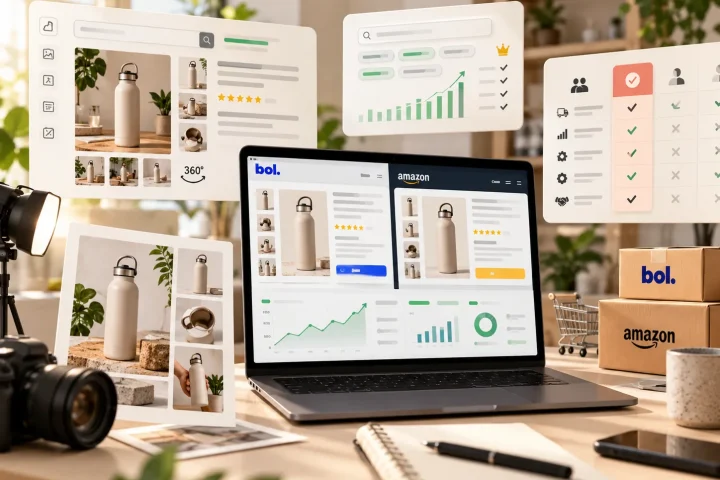
An e-commerce agency for web shops is not automatically strong in marketplaces. That is an important difference. Your own web shop gives more room for brand story, layout, extra content and full control over the customer journey. On bol.com, Amazon or Kaufland the boundaries are tighter. There you have to convince faster within fixed formats, rules and search behaviour.
If marketplaces matter for your growth, ask about them early on. Not just: “Can you do bol.com too?” But more concretely:
- How do you build a listing for scannability and trust?
- How do you translate product benefits into images and bullet points?
- How do you make sure content is right for each channel without the brand style falling apart?
- Can you carry the same product line through to web shop, bol.com and Amazon?
- How do you set up the process when there are many products or variants?
For BrandMonks, bol.com listings and Amazon listing optimisation are not separate side products. They are part of the same e-commerce content approach. A product must look professional, recognisable and convincing on every sales channel, but adapted to the role of that channel.
Look beyond a one-off improvement
Many entrepreneurs look for an e-commerce agency at the moment something needs to improve. The web shop is not selling enough. The listing feels weak. The brand presence is messy. New products take too long. Those are good reasons, but you make the best choice by looking beyond the first fix.
Ask yourself whether the agency only solves the visible problem, or also the cause behind it. A product page can be written better, but if every new product then becomes a separate discussion again, the same problem returns. A listing can be made visually stronger, but if the template is missing, scaling stays slow. A web shop can look nicer, but if product information and image structure do not move with it, conversion stays limited.
A good e-commerce agency therefore helps with repeatability. That does not have to be heavy or complicated. Sometimes it starts with a fixed product page layout. Sometimes with an image template for a product series. Sometimes with a better brief for AI product images, packshots or listing visuals. The goal is always the same: get to usable output faster without your brand getting messier.
Judge the partnership on execution, not just strategy
Strategy matters, but e-commerce only grows when the execution is right. So when choosing an agency, look at how practical the partnership will be.
For example, ask how the agency gets from input to output. What information do they need? Who writes or structures the product benefits? Who decides which visuals are needed? How are corrections handled? How is consistency safeguarded when several products are in progress at once? And what happens after the first set goes live?
This is especially important with product content. The value lies not only in the first design, but in the ability to carry that line through reliably. An e-commerce agency that is good at scalable execution therefore thinks early on about formats, components, image roles, copy structure and handover. Not because process is interesting in itself, but because it stops you starting from scratch with every new product.
If you also want to strengthen your own web shop, it makes sense to look for a partner who understands the web shop itself. Our web shop approach fits in with that: brand, content and conversion-focused pages have to work together, not as separate layers stacked on top of each other.
Signs that an e-commerce agency is not a good fit
Not every agency that does good work automatically suits your situation. So watch out for signs that could cause friction later on.
A first sign is an overly broad promise without clear boundaries. If an agency says it does everything but cannot explain where the most impact lies for your web shop, comparing becomes difficult. A second sign is that the talk is mainly about tools, platforms or campaigns, while your problem actually lies in product communication. Then you may get more traffic to a page that still does not convince well enough.
A third sign is that there is no plan for volume. For a web shop with a handful of products, a one-off approach can still work. For a brand with many products, variants or marketplaces, that is riskier. Then you want to know in advance how the agency safeguards consistency and how new content can be produced faster.
A fourth sign is that the agency sees your brand style as separate from commercial output. Beautiful visuals are not enough if they do not remove uncertainty. And conversion-focused copy is not enough if the images do not feel professional and recognisable. In e-commerce, those two have to come together.
When BrandMonks is a logical choice
BrandMonks is mainly a logical choice when your growth depends on better product communication. Think of web shops, brands and marketplace sellers who want to improve their product pages, listings, visuals and content workflow.
We are not the agency that only manages campaigns or only builds technology. Our strength lies in translating brand, product information and commercial goals into scalable content. That can mean AI lifestyle images based on client photos, consistent packshots, marketplace listings, product copy, templates or a visual structure that lets a larger range go live professionally, faster.
That often puts us right between strategy and execution. We think along about what a customer needs to see to buy with more confidence, but we also create the content needed for it. That matters, because e-commerce entrepreneurs usually have no need for yet another abstract advisory document. They want output that can go live, fits their brand and is repeatable for the next products.
If you are mainly looking for more advertising, pure development or fully operational marketplace management, a different type of agency may be a better fit. If you are looking for a partner who makes web shop and marketplace content stronger, more consistent and more scalable, BrandMonks is a better match.
Frequently asked questions about choosing an e-commerce agency
What is an e-commerce agency?+
An e-commerce agency is an agency that helps web shops, brands or marketplace sellers grow online. What that involves differs per agency. Some agencies focus on technology, others on marketing, marketplaces, content or design. So do not just look at the term, look at the specialisation behind the agency.
How do you choose the best e-commerce agency?+
Choose the agency that fits your biggest growth blocker. If you have too little traffic, marketing is the obvious choice. If you have lots of visitors but few buyers, look at product pages, trust, visuals and content. If you have many products or channels, choose an agency that understands scalable product content.
What is the difference between an e-commerce agency and a marketing agency?+
A marketing agency often focuses on visibility, campaigns and traffic. An e-commerce agency looks more broadly at the sales environment, such as the web shop, product pages, marketplaces, content and conversion. Some agencies combine both, but the core specialisation still matters.
When should you bring in an e-commerce agency?+
Bring in an e-commerce agency when growth stalls and internal capacity or expertise falls short. That could be with a new web shop, a larger range, expansion to marketplaces, disappointing conversion or the need for more professional product content.
What should you look for in an e-commerce agency for marketplaces?+
Look for experience with channel requirements, listing structure, product images, keywords, scannability and scalability. A good marketplace approach does not blindly copy your brand across, but adapts product content to how customers search and compare within the channel.
Choose on your growth question, not on the biggest promise
Choosing an e-commerce agency gets easier once you stop looking for the agency that can do everything. The better question is: which agency solves the problem that is holding back your growth the most right now?
For some web shops that is technology. For other web shops it is traffic. But for many e-commerce brands the gain lies in clearer product communication, stronger visuals, better listings and a workflow that gets new products live faster. Then you do not need a general promise, but a partner who can make content scalable without diluting your brand.
Related articles:
- E-commerce agency for web shops and marketplaces
- Increasing product page conversion
- E-commerce content systems
- Product content for marketplaces
Want to know whether BrandMonks is a fit for your web shop, range or marketplace ambitions? Book an intake call. Together we will look at where content, visuals and listings can make the most impact right now.

Melle Sikma
Helmsman
melle@brandmonks.nl