


E-commerce content automations you can put to work right now
Typing yet another product description. Cropping yet another set of images for the next sale. Translating a whole product line for the German market. Sound familiar? That endless stream of repetitive tasks that comes with managing e-commerce content.
Many business owners accept this as ‘part of the deal’. It is manual, time-consuming work that simply has to be done. We see it differently. We see it as a huge brake on your growth. Every minute you spend copy-pasting is a minute you do not spend on strategy, marketing or customer contact. It is time to break that cycle. Not with vague promises about AI, but with concrete, practical automations you can implement today to save time and reduce mistakes.
In this article
- What do we really mean by content automation?
- Why a central source for product data is not a luxury
- Creating visual content at scale without a photo studio
- The role of AI in writing and translating
- How do you start small but effectively?
What do we really mean by content automation?
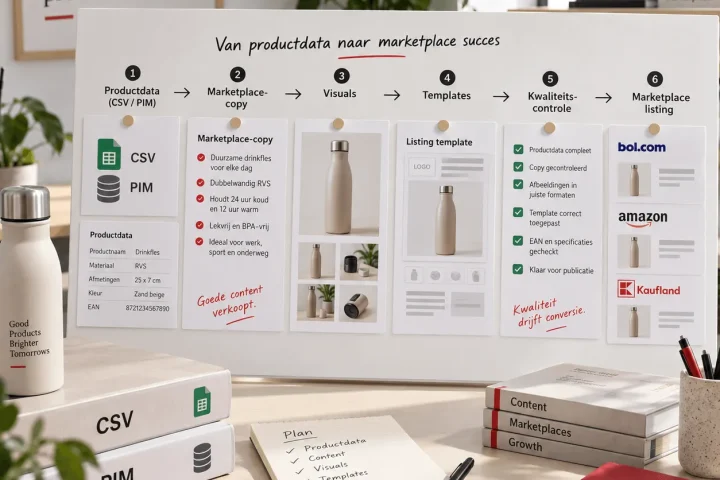
Let us clear up a misunderstanding first. When we talk about automation, many people picture thinking robots that take over all the work. The reality is a lot more practical and accessible. E-commerce content automation is about setting up systems smartly to take repetitive tasks off your hands. The aim is not to replace people, but to make people more efficient.
Think of processes such as:
- Automatically generating product descriptions based on fixed specifications (brand, material, dimensions).
- Adjusting product images in bulk, for example by adding a ‘New’ or ‘Sale’ label.
- Synchronising stock and product information across multiple channels such as your own web shop, Bol.com and Amazon.
- Automatically translating content, with a built-in check step.
The point is to let the machine do what it is good at: repeating tasks without making mistakes. That leaves you time for creativity and strategy. That is where you make the difference.
Why a central source for product data is not a luxury
Where does it often go wrong? At the source. Product information is scattered across countless Excel sheets, in notes, in a colleague’s inbox. One small update means changing something in ten different places. That is not just inefficient, it is a guarantee of mistakes. An outdated price here, a wrong dimension there. It undermines your customer’s trust.
The solution is working from a ‘single source of truth’. One central place that holds all product information. This can be a PIM system (Product Information Management), but even a well-structured database or spreadsheet is a start. From this one source, the data is then pushed to every channel. A price change? You change it once in your central system and it is automatically applied on your website, your app and all marketplaces. This is the foundation for any serious automation. Without it, you keep putting out fires. It is also an indispensable step if you sell on multiple platforms, such as your own shop and, for example, Bol.com. Keeping that information correct and consistent is a full-time job, unless you automate it. Considering the step to marketplaces or want to understand the differences better? Then read about the differences between Bol and Amazon.
Creating visual content at scale without a photo studio
You have a new product in five colours and three sizes. Does that mean fifteen different photo shoots? Of course not. Yet we see many web shops struggling with the production of visual content. It is expensive, it takes time and it is hard to keep things consistent. This process can also be largely automated.
One of the most effective methods is using 3D product renders. We create a perfect digital model of your product once. We can then render that model in any colour, setting or angle you like. A new colour variant? That is a change of a few minutes, not a new day-long photo shoot. This not only saves an enormous amount of money and time, it also ensures perfect brand consistency across all your product photos.
Another, simpler form of automation is using image templates. Imagine a template in which the dimensions, the position of the product and the background colour are fixed. New product photos are automatically placed into it and cropped to size. Add a layer that can place a discount sticker dynamically, and you have a powerful tool that saves you hours of work during sale periods.
The role of AI in writing and translating
Yes, of course we have to talk about AI. But in a down-to-earth way. Is AI a magic solution that writes all your content for you? No, absolutely not. Can it be a powerful assistant that speeds up your process? Definitely. The key is to see AI as a starting point, not as the end result.

Use AI to generate a first draft of a product description based on the specifications from your PIM system. It gives you a structure and the basic text. After that it is up to a human marketer to add the right tone of voice, persuasiveness and brand personality. An AI does not understand the emotional nuance needed to convince a customer. It cannot write ‘between the lines’.
The same goes for translations. Tools such as DeepL are fantastic for a quick first translation of your content. But never, ever send that output straight to your live web shop. Cultural nuances, specific terms and the ‘flow’ of the language get lost. Use the AI translation as a basis and let a native speaker perfect the text. It still saves a huge amount of time compared with translating from scratch, but you avoid painful and unprofessional blunders.
How do you start small but effectively?
The world of automation can seem overwhelming. But you do not have to turn your whole business upside down at once. The trick is to start small, where the pain is greatest. Which content task costs you the most hours every week and causes the most frustration? Is it cropping images by hand? Is it copying product data into different systems? Start there.
Take that one repetitive process and find a tool or a method to automate it. The time you free up is instant profit. You can then invest that profit in tackling the next bottleneck. That way you build a more efficient content ecosystem step by step, without huge upfront investments. Automation is not an ‘all or nothing’ game. It is an ongoing process of improvement. Take that first step today.
Curious which automations could deliver the most return for your e-commerce business? We are happy to think along with you. Let us look at where the opportunities are. Get in touch with us for a no-obligation chat.

Melle Sikma
Helmsman
melle@brandmonks.nl