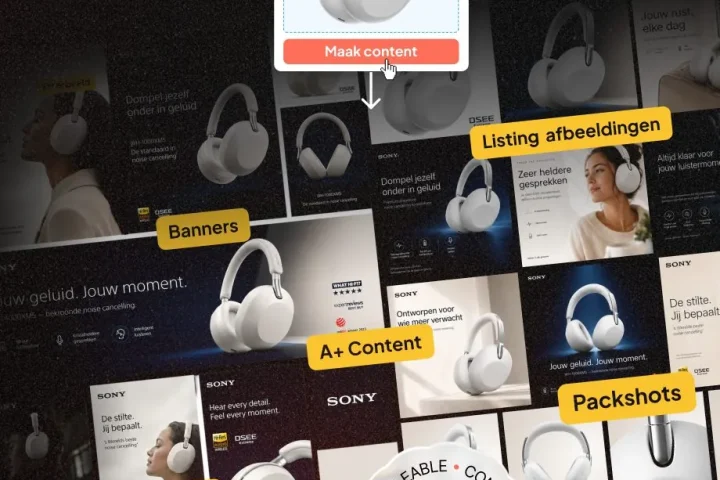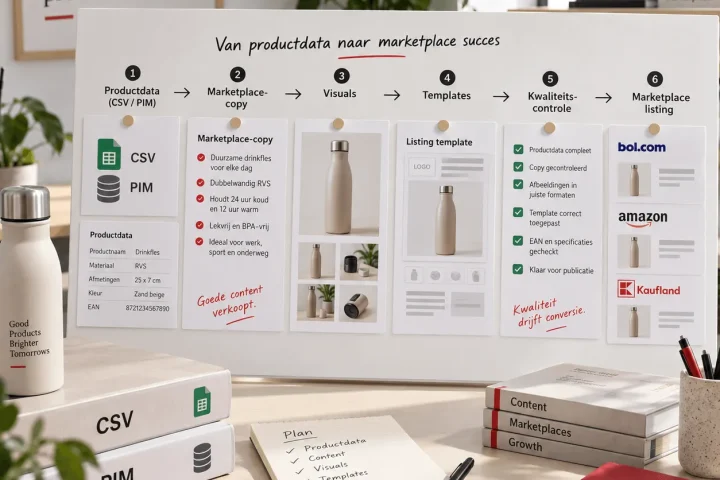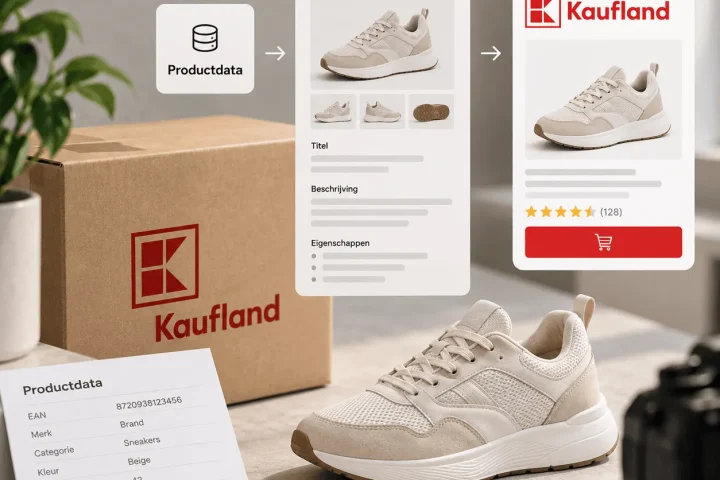
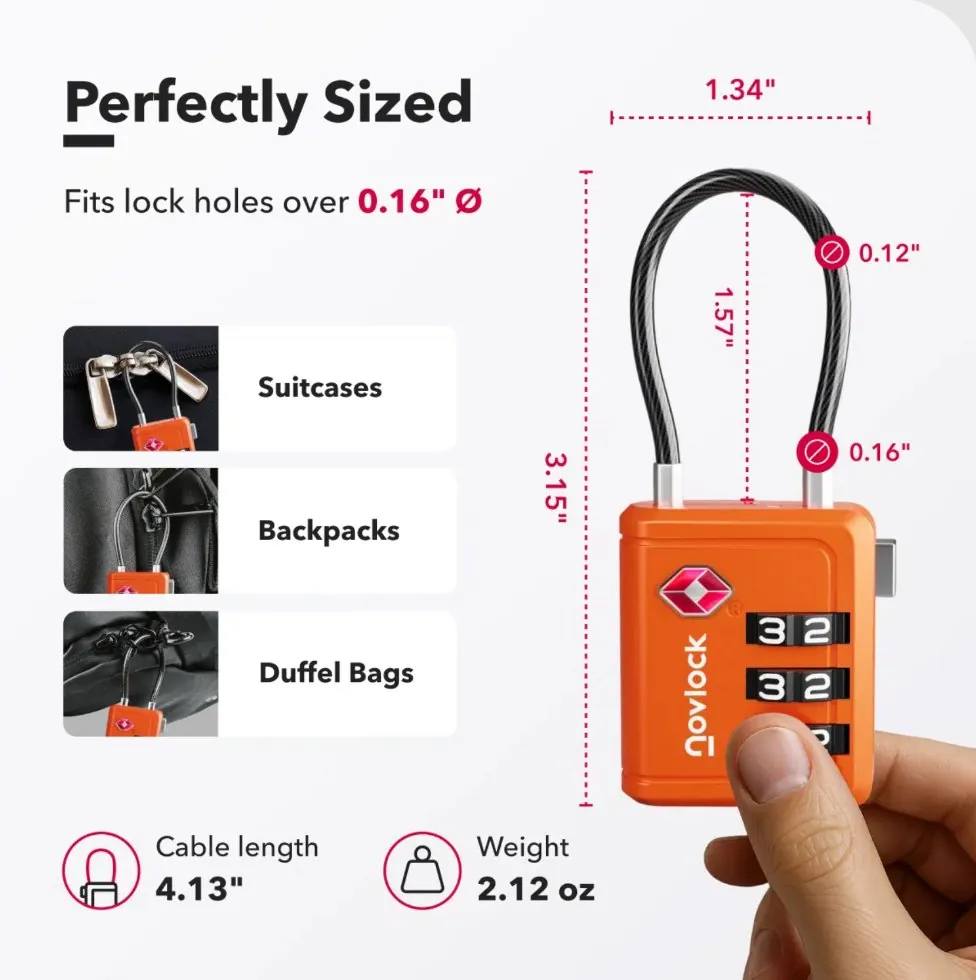

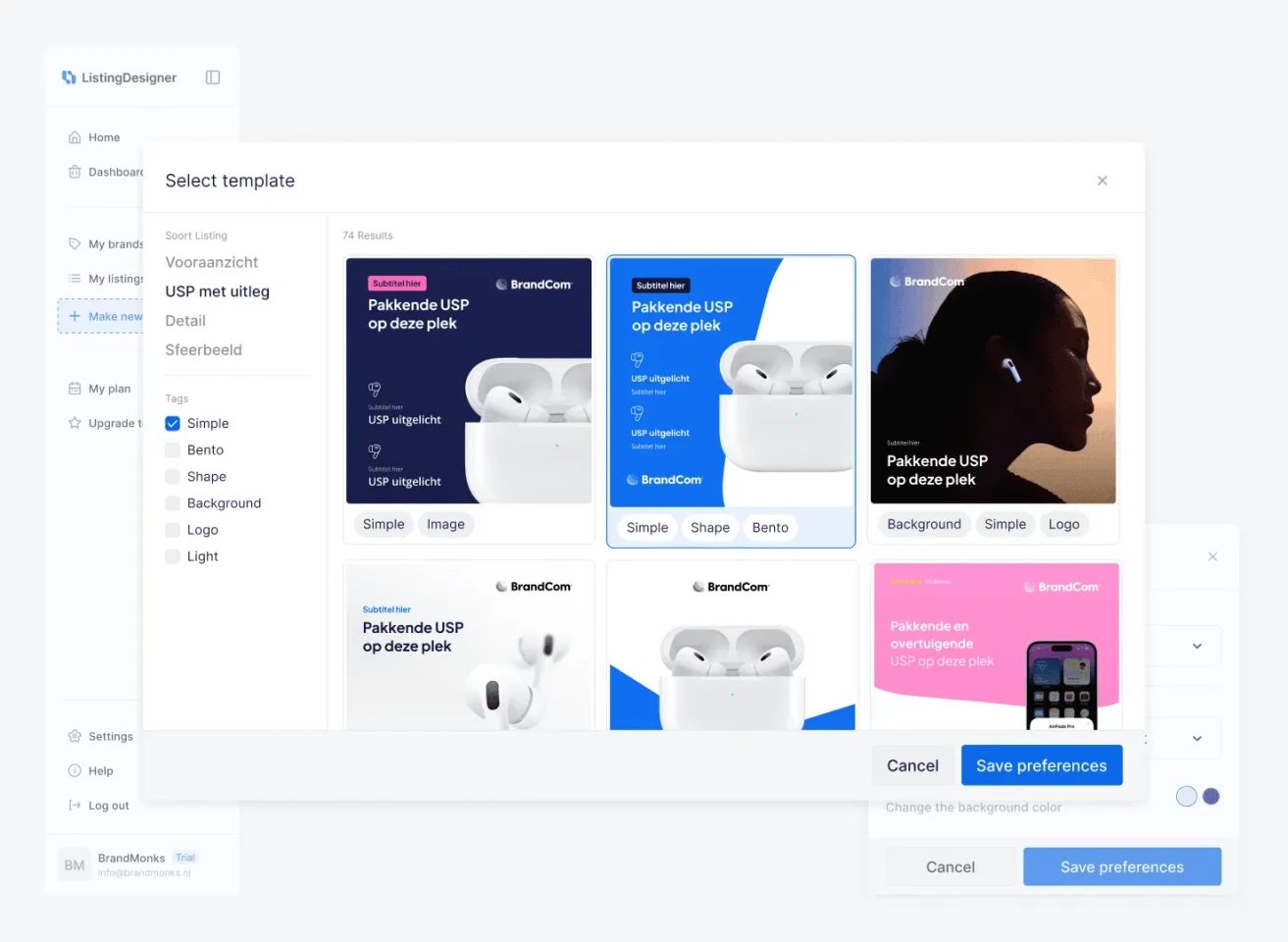
Creating listing templates that really stay scalable
Creating listing templates is only valuable if templates genuinely speed up production without your listings becoming generic, messy or hard to manage. A good template is therefore not a nice fixed framework, but a reusable structure that gets product understanding, proof and channel fit right again and again.
This page is deliberately about execution. Not about design systems in general or broad process models, but about the practical question of how to use listing templates for product ranges, variants and different sales channels. The goal is simple: make consistent listings faster without having to build every new product again from scratch.
At BrandMonks, the gain here lies mainly in repeatable visual logic. As soon as teams stick to fixed template blocks, clear agreements on updates and limited exceptions, the pressure of revisions falls and output speed rises. Templates then become a way to repeat strong output well more often.
If you want the broader framework behind this approach first, read e-commerce content systems. This page zooms in on templates as a direct accelerator of listing production.
Why many listing templates become unusable in practice
Many teams create templates with a good starting point: saving time, increasing consistency and less discussion in production. Yet templates often get stuck in practice. Not because the idea is wrong, but because the template is seen too early as the final solution instead of as part of a working production process.
The first mistake is that templates are often visually neat but too vague in content. There is a fixed layout, but it is not defined sharply enough which information or which proof belongs in each block. As a result, teams still improvise within each template and the output drifts apart again.
The second mistake is that exceptions creep in too easily. Every special product gets just one extra block, an adjusted order or a different visual. In the short term that feels logical. In the longer term it turns a template library into a collection of half-overlapping variants that are harder and harder to manage.
The third mistake is that many listing templates are judged on speed alone. The turnaround time may then seem lower, but you lose distinctiveness, scan logic or conversion power. A template that is produced faster but performs worse commercially is not a gain.
Quick template audit: where are you losing speed or consistency now?
Before you expand or clean up templates, you first need to determine exactly where the current delay or clutter arises. In many teams the problem is not in designing the template itself, but in the way it is used, updated or interpreted. A short audit makes that visible straight away.
The first check is whether your template blocks are defined sharply enough in content. If a block is only visually recognisable but stays open in content, you still get too much room for interpretation. That makes reviews slow and lets listings drift apart unnecessarily.
The second check is whether variants within one product family depart from the same template in a fixed way. Without that logic, every variant becomes a separate mini project. You may still call it a template flow, but in practice you are largely working by hand again.
The third check is whether updates carry through in a controlled way. If teams do not know which template version is leading or when a change should be rolled out more widely, you get version chaos. You often see that reflected in inconsistent listings within the same category.
| Audit point | Typical problem | First step |
|---|---|---|
| Block definition | Teams fill in the same template differently each time | Record the goal, minimum content and rejection criteria per block |
| Use of variants | Variations are solved ad hoc outside the template | Set up fixed variant rules per product family |
| Update management | Old and new template versions get mixed up | Work with one leading library and fixed update rounds |
The core structure of a strong listing template
A strong listing template does not start with design, but with order. The template has to determine what a customer sees in which order and why that helps them understand, compare and trust faster. As soon as that logic is missing, the template mainly remains a visual grid without a real commercial function.
In most categories a template works best when it first establishes product understanding directly, then shows relevant context and then gives proof of difference or quality. Only after that come depth, detail or choice support. That order matters because a listing is usually scanned in seconds, not read in minutes.
Even within a fixed layout, every block has to keep a clear role. A hero block has to make clear immediately what the product is. A proof block has to show a real difference, not just repeat what was already known. A detail block has to remove uncertainty, not simply add extra filler. As soon as blocks lose those functions, the template gets heavier without getting better.
A good template therefore guards not only the layout, but also the discipline of the content. It makes sure product understanding, proof and choice support come back in the right proportion. It is exactly that proportion that makes the difference between a template that delivers scale and a template that only produces listings that look alike.
For visual execution that touches directly on the images themselves, creating product images in bulk is the logical next read.
Template flows for product ranges and variants
A template only becomes truly scalable when it works not just for one listing, but for a whole product range. That calls for a template flow: a fixed basic structure that holds per product family, while variants can depart from it in a controlled way where that is commercially necessary.
The most important principle is that you do not see every difference as a reason for a new template. Many variants can make do with the same basic layout, as long as there is room within specific blocks for other claims, other proof points or an adjusted visual. That keeps the library smaller and production more predictable.
At the same time, reuse must not tip over into flat output. If a variant raises a different buying question, for example because of different use, a different size expectation or a different application, the template has to respond to that. Not by redesigning everything, but by allowing pre-defined departures in the places where they make a difference.
That combination of a fixed basis and controlled departure is what makes template-based listing design strong. You gain speed because not every product has to be reinvented, but you keep enough room to make relevant differences visible. That is exactly where the commercial value of good template flows lies.
Channel-specific templates for web shop, Bol and Amazon
A common mistake is to confuse channel-specific templates with completely different content. In practice that is rarely necessary. What is necessary is a shared core structure that is weighted differently per channel. That way you avoid double work without your listings losing their platform fit.
A web shop page often has more room for context, brand story and depth. For a marketplace listing, the template has to establish product understanding and direct proof faster. That does not mean you need two separate systems. It means you need one strong basis with a clear channel translation.
That channel translation usually lies in emphasis, order and length. A block that comes later in the flow on the web shop may be needed earlier on Bol or Amazon. A context image that works well in your own shop may get less priority on a marketplace when a directly comparable benefit carries more weight.
Strong web shop and marketplace listing templates are therefore not identical, but they are not designed separately from each other either. They share one core of content and translate it to the channel in a controlled way. As a result, your brand story stays consistent in content, while the presentation fits the environment better commercially.
For the concrete channel execution, you can continue to Bol listing and Amazon listing design.
Figma template libraries and component logic without version chaos
The practical Figma side is only relevant here insofar as it directly helps with listing templates. The essence is not that you have “a design system”, but that you manage a template library that lets teams produce faster, more consistently and with fewer misunderstandings.
A usable Figma library starts with components per template function, not per individual campaign or client request. Think of blocks for hero, proof, comparison, detail or variant choice. Once those functions are clear, they can be reused much more easily across product ranges.
Version management is just as important here as the design itself. If teams work on different variants of the same template at different times, invisible departures soon appear. That is why updates should be rolled out in fixed rounds. Not continuously and ad hoc, but at moments when it is clear which change becomes leading for wider production.
Naming also deserves discipline. A team should be able to see straight away which template is meant for which product family, which variant is active and which version is the current standard.
That is not a theoretical layer of governance but practical management that stops a template library from turning into an opaque collection of nearly identical files.
For service-focused execution, you can continue where relevant to listing design template.
Quality control: when is a template commercially good enough?
A listing template is not “done” as soon as it looks neat or can be filled in quickly. The real question is whether it helps you make good listings faster that support product understanding, trust and conversion. That is why quality control has to go further than visual consistency alone.
The first test is whether the template holds up the same core logic across several products in the same family. If a template only works for the example it was designed on, but collapses as soon as variants or edge cases come into view, it is not yet a scalable template.
The second test is whether the template preserves commercial clarity. Every block has to make a clear contribution to understanding or persuasion. As soon as a template looks sleek but makes customers grasp what is relevant less quickly, the team may gain production time but loses on effectiveness.
The third test is whether the template makes review simpler instead of more complicated. A good template reduces room for discussion because it makes clearer what belongs where and when something departs from it. If the same conversations come back in every batch, the template is not sharp enough yet.
KPIs for template-driven listing production
Templates only really earn their place when you can measure that they improve production and output. You do not need a big dashboard for that. A small set of KPIs is usually enough, as long as you know in advance which correction follows each signal.
First-pass approval rate shows whether your template is clear enough for the teams working with it. If that score stays low, the template is probably too open, too vague or too dependent on individual interpretation. Rework ratio shows how much repair work the template flow still causes. If that value stays high, the promised gain in scale has not yet been realised.
Visual cycle time is also important, because templates have to deliver speed in practice. Not just on paper, but in real production. Content mismatch rate then shows whether the template sets the right expectations once the listing is live.
| KPI | What it signals | Correction |
|---|---|---|
| First-pass approval rate | Whether teams can apply the template correctly and consistently | Clarify block roles and the limits of what goes in them |
| Rework ratio | How much repair work the template flow still causes | Cut unnecessary variation and review exceptions |
| Visual cycle time | Whether templates really shorten the turnaround time | Remove handover noise and simplify the update flow |
| Content mismatch rate | Whether template blocks set the right expectation | Adjust the order, proof or detail blocks |
Frequently asked questions about creating listing templates
How do you know whether a listing template is good? Not because it looks neat, but because it holds up the same commercial logic across several listings without causing extra rounds of revisions.
When do templates work better than individual designs? Especially with product ranges, recurring listing structures and teams that have to roll out lots of variants or channel versions. Repeatable structure then saves time straight away.
Does a template not make your listings too generic? Only if you confuse structure with content. A good template standardises the order and block roles, but leaves room to differentiate proof, context and emphasis properly per product.
Does every channel need its own template? Not entirely. One shared core structure usually works better, with clear channel adjustments in emphasis, order or block length.
Can a smaller team use templates well too? Yes. Smaller teams in particular often benefit faster, because a good template prevents a lot of coordination and repair work.
Conclusion: good templates speed up output without becoming generic
At its core, creating listing templates is not a design exercise but a choice about scale. You record which structure works again and again, where variation makes sense and how you keep updates manageable. That makes production faster without your listings having to become flat in content.
For BrandMonks, the gain lies in templates that genuinely help with day-to-day execution: clear block logic, workable variant rules, channel translations without double work and a library that does not get bogged down in version chaos. Templates then become an accelerator of strong listing production instead of a source of new friction.
You can read more about this topic in e-commerce content systems, creating product images in bulk and e-commerce content automation.
Want to apply this to your own product ranges and listing flow? Then book an introductory call. We will then make concrete which template structure delivers the most speed and consistency in your situation.

Melle Sikma
Helmsman
melle@brandmonks.nl