
Amazon A+ content in 2026: when it really adds value
Amazon A+ content is often seen as a quick upgrade for any listing. In practice it mainly delivers results when the basic listing is already right and A+ is used to make the choice faster and more certain.
At BrandMonks we see that A+ works best as part of a bigger system: a clear proposition, strong visual language and a tight module order.
In this article we focus on execution: when A+ makes sense, how you choose modules, how you prevent mistakes and how you measure the return. For the listing basics in general, go to amazon listing optimisation.
When A+ content is and is not the right step
A+ content is not a replacement for weak basic information. If the title, bullets and image foundation are not in order, A+ usually solves too little.
A+ is especially strong in three situations:
- your product needs extra explanation or context;
- you need to differentiate clearly in a busy category;
- you want to build brand trust across several ASINs.
A+ is less effective when your core proposition is unclear or when the operational basis and review quality lag behind. Then you need to repair the foundation first.
Decision model for priority
Use three quick criteria to set priority. First: product complexity, because the more complex the product, the greater the chance that extra explanation helps conversion. Second criterion: competitive pressure on comparable ASINs, because differentiation adds value faster there. Third criterion: mismatch signals in reviews and return reasons. If two of the three criteria are positive, A+ is usually a logical next step.
Brand Registry and A+ content: how they connect
Without Brand Registry you have limited control over brand presentation. With Brand Registry you can use A+ structurally and secure brand consistency across listings.
That relationship matters in practice. Registry gives you control, A+ gives you story structure. Only together do they form a scalable brand layer that goes further than loose product copy.
If there is internal discussion about the order, use this principle: first a stable basic listing, then securing Registry, after that rolling out A+ per product group.
Choosing modules: build a logical decision path for the buyer
Many A+ pages show a lot of information, but little decision structure. The buyer then gets content, but no clear route to a choice.
Work with a fixed module order
Module 1: core promise
Open with the central benefit and the primary use case.
Module 2: layer of proof
Show why your claim is right with facts, details or comparative context.
Module 3: differentiation
Make clear why this product is a better fit than the alternative.
Module 4: trust and wrap-up
Remove any remaining doubt with clear expectations and practical reassurance.
A fixed module logic makes A+ faster to build and easier to optimise across several products.
Choosing modules per product type
Not every product calls for the same order. For functional products, a route of problem, solution, proof usually works best. For design-led products, context and brand feel first, then technical backing, often works well. For bundles or sets, it is smart to show coherence and the use scenario first, and only then details per item. This nuance prevents standard modules that look visually neat but miss the buyer in content.
Asset requirements: quality and consistency for better conversion
A+ performance depends heavily on asset quality. Blurry visuals, inconsistent styles and overloaded text break down trust in seconds.
Important quality rules:
- every visual has a clear function;
- text blocks stay scannable and concrete;
- claims stay verifiable and not exaggerated;
- style and tone of voice are consistent with the rest of your brand.
For teams that manage lots of assets at the same time, standardisation is a must. That is why we often link A+ projects to content design and product images (3D, AI and editing of existing images), so that brand and conversion goal stay in line.
Standard A+ versus Premium A+
Many brands wonder whether they need Premium A+ straight away. In practice that depends on product complexity, competitive pressure and the quality of the assets available.
Standard A+ is often enough if you have a clear proposition and mainly want to increase basic trust. Premium A+ becomes more interesting when you need more room for storytelling or want to build up several layers of argument visually.
Do not choose on looks alone, but on impact on the decision. If extra modules do not add extra clarity, they rarely add extra conversion.
Compliance and common mistakes
A+ content often fails not on creativity, but on incorrect claims, unclear wording or inconsistent application of guidelines.
Five mistakes to avoid
- too much generic marketing language without proof;
- a module order without a logical storyline;
- claims that do not match product details;
- overloaded visuals that are hard to scan;
- no periodic recalibration based on performance.
Compliance does not just mean following rules, but also setting consistent expectations. As soon as expectation and reality drift apart, review damage and return friction rise.
Governance on claims and approvals
Record internally who validates claims on content and who gives final approval for publication. Without that step, promises soon creep into the content that seem commercially attractive but are not sustainable operationally. So work with a fixed check: claim, source of proof, approver and revision date. That governance prevents costly rounds of corrections and protects your brand reputation in the longer term.
Measuring the effect of A+ content: steering, not guessing
You should treat A+ as an improvement round with measurement frameworks. Without a measurement plan it stays a design project instead of commercial optimisation.
A workable measurement approach:
- record baseline values for conversion and relevant behavioural metrics before going live;
- set an evaluation period in advance;
- compare against comparable listings or periods;
- decide in advance when you scale up, rebuild or roll back.
Do not just measure direct revenue, but also quality signals such as the returns trend and how reviews develop. That is exactly where you see whether your message lands well.
Also watch out for measurement errors caused by simultaneous changes outside A+. If price, stock or advertising pressure changes in the same period, that can distort your conclusions. So keep a changelog per ASIN in which you note all important changes. That lets you separate better, during evaluation, what was probably down to A+ and what was down to other factors.
Scalable A+ production with Figma templates and components
When you have several products or variants, producing A+ by hand soon becomes slow and error-prone. You then need a scalable content engine.
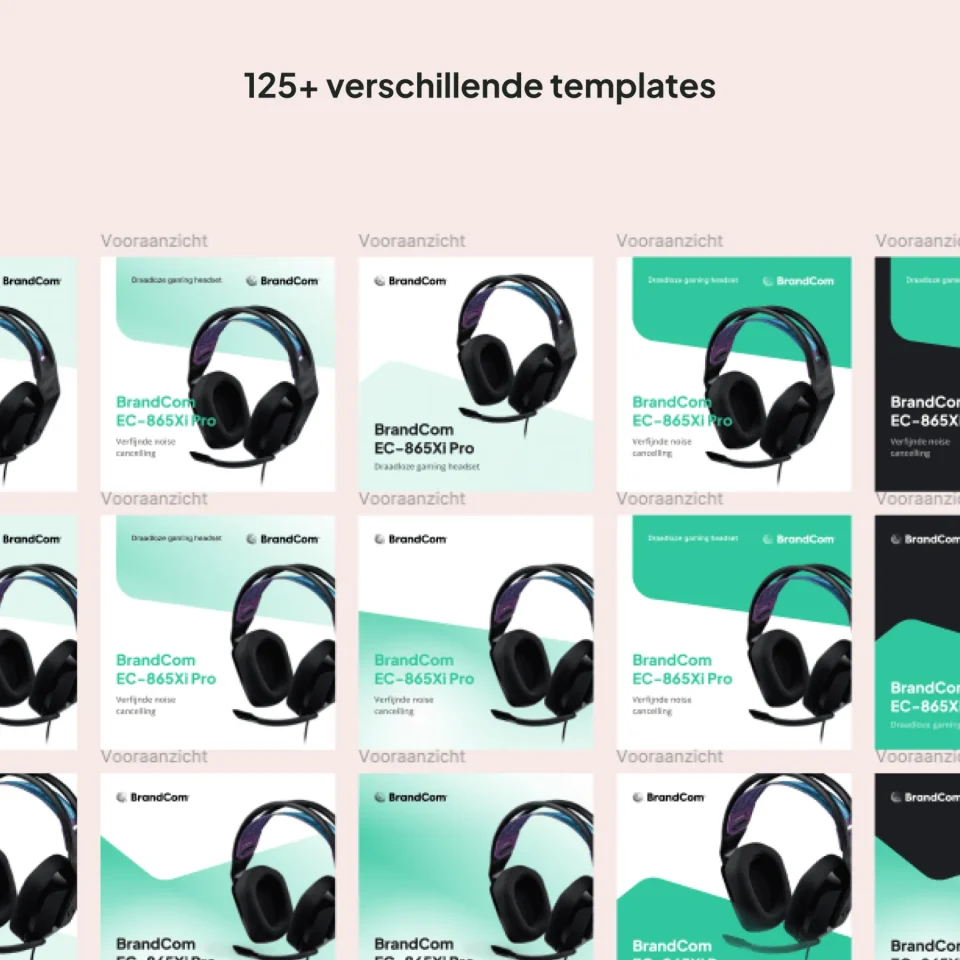
At BrandMonks we build A+ systems in Figma with components, module templates and fixed content blocks. That lets you roll out faster, stay consistent and adjust more easily based on new data.
What this delivers:
- a shorter turnaround time from briefing to going live;
- a lower chance of errors in visuals and claims;
- consistent brand language across product ranges;
- faster reuse of proven module logic.
This approach suits brands that do not see A+ as a one-off action, but as a structural growth process.
An extra advantage of working with templates is faster governance. If modules have already been validated on structure and compliance, the team mainly has to check claims, specifications and product context for each new roll-out. That shortens the turnaround time without compromising on quality.
30-60-90 approach for rolling out A+
A phased approach prevents you from changing too much at once and no longer being able to trace the effect.
Days 1 to 30: selection and blueprint
Choose the product groups with the highest potential and define the module order plus asset requirements.
Days 31 to 60: production and going live
Build modules based on the template and component structure, check compliance and publish in phases.
Days 61 to 90: measuring and scaling up
Analyse the effect on conversion and quality signals, improve modules and roll out the proven approach to the next groups.
That way A+ stays manageable, even as your range grows.
In this phase, also keep a fixed backlog of points for improvement per module type. If you see that a certain proof block consistently performs better than other variants, make it the new standard. That way your system grows on the basis of data instead of preference. That learning cycle makes the difference between a neat A+ page and a structurally scalable A+ approach.
Frequently asked questions about Amazon A+ content
When does A+ content have the most impact?
Especially with products where extra explanation and differentiation are needed to speed up the choice.
Do I need to sort out Brand Registry first?
Yes, in practice that is the basis for using A+ structurally and consistently.
What matters more: standard or premium A+?
Not the label, but the clarity of your module story determines the result.
How soon can you measure the effect?
You often see the first signals within a few weeks, provided you record baseline values and a measurement window in advance.
Can A+ make up for a weak basic listing?
Only to a limited extent. Without a strong title, bullets and basic images, the impact usually stays too small.
When is outsourcing a smart move?
When you do not have the internal capacity to keep strategy, assets, compliance and iteration up to standard at the same time.
Conclusion: A+ content works best as a scalable system
Amazon A+ content delivers the most when you use it as part of a bigger conversion system. Not loose modules, but a clear route from promise to proof and trust.
At BrandMonks we therefore link A+ to strategy, module logic and scalable production through templates and components. That way you can not only make a page look better, but structurally prompt better choices at product level.
This approach makes sure optimisation does not stop after going live, but continues as a fixed part of your marketplace operation.
Want to find out where A+ is the biggest lever in your range? Then book an introductory call. We will translate your current situation into a workable roadmap with clear priorities.
Further reading:
- Amazon listing optimisation
- Marketplace performance
- Increasing marketplace conversion
- Bol listing optimisation

Melle Sikma
Helmsman
melle@brandmonks.nl