

Increasing marketplace conversion in 2026: where the biggest gains really are
Many teams on marketplaces focus on reach first, but growth stays fragile if conversion lags behind. More impressions without better click-through and order rates mainly put pressure on operations and margin.
At BrandMonks we see that sustainable growth happens when you manage conversion as a chain: from the first impression to return behaviour after purchase.
In this article we focus on the practical route to increasing marketplace conversion without jumping straight to price cuts. If you are looking for the broader strategic framework first, marketplace performance ties in. For listing depth, go to bol listing optimisation.
Why traffic often rises while results lag behind
An account can get more traffic and still make little net progress. That happens when you steer in the wrong place in the funnel. Many dashboards mainly show sessions and revenue, but not where friction arises.
In practice we usually see three patterns. First: CTR is mediocre because of a weak first impression in the title or main image. Second: the product page does not convince quickly enough, so add-to-cart lags behind. Third: orders come in, but return pressure and service friction eat away at the margin.
Without that chain view, you end up treating symptoms. You might lower the price, for example, while the real problem is the order of information or managing expectations.
The marketplace funnel you need to master
Conversion on marketplaces is not a single figure, but a continuous route with clear transitions.
Impression to click
This is where your listing wins or loses in seconds. Title relevance, visual clarity and positioning against competitors decide whether someone clicks through.
Click to product evaluation
After the click, the buyer wants to understand quickly whether this is the right choice. A cluttered structure, vague bullets and missing evidence make doubt grow.
Evaluation to order
At this point, reducing risk is what counts: do expectations about delivery, quality, use and limitations match? The less doubt, the higher the completion rate.
Order to return
Only here does it become clear whether your conversion was profitable. An order with a high chance of being returned is not healthy growth.
If you monitor these transitions separately, you see much faster where you need to step in.
KPI structure: balancing leading and lagging indicators
Marketplace CRO works best with a small, hard dashboard. Not measuring everything, but the metrics that speed up decisions.
Leading indicators
- click rate on core listings;
- add-to-cart trend;
- questions and objections in reviews and support;
- deviations in delivery performance and cancellations.
Lagging indicators
- net margin per product group;
- stable conversion rate over a period;
- return rate with breakdown of reasons;
- sustainable ranking development.
Link every KPI to an owner, a response time and a standard action. Without ownership, every dashboard remains mostly reporting.
Conversion levers at listing level
If you want to increase marketplace conversion, you have to prioritise tightly at listing level. The biggest levers usually lie in first impression, order of information and trust.
The first lever is title plus main image. That pair decides whether you stay in the running in the first scan. The second lever is bullet structure: benefits, evidence and practical use in a logical order. The third lever is managing expectations in the description and visual context, so return friction drops.
You should not improve this layer ad hoc. Work with fixed templates, test windows and clear decision rules. The detailed approach to copy and visual architecture is on bol listing optimisation.
Increasing conversion without immediate price cuts
Price is a tool, not a strategy. Many teams lower prices too quickly to absorb conversion dips, but pay for it later in margin pressure and dependency.
The better route is to strengthen perceived value. Make benefits more concrete, comparisons clearer and uncertainty smaller. That increases the chance a buyer chooses you without you having to sit below the market structurally.
Work with predefined price limits:
- below the margin threshold: no price action, improve the listing or operations first;
- within the bandwidth: only a temporary price action with a set evaluation moment;
- above the target margin: room to accelerate volume in a controlled way.
For accounts where Buy Box pressure dominates, link this to a ranking approach via bol ranking factors.
A practical intervention matrix helps here. If CTR is low and conversion is low too, start with the first impression plus the structure of your arguments. If CTR is high but conversion is low, focus on product page friction and managing expectations. If conversion is reasonable but return pressure is rising, the priority is clearer context of use, limitations and service expectations. That way you link every problem to a fitting action without leaning on price straight away.
Always use the same data sources per cycle: listing metrics, return reasons and support questions. By reading those three together, you see faster which friction weighs heaviest commercially.
Experiment design that works within marketplace limits
On marketplaces you cannot A/B test everything the way you can in your own web shop. Even so, you can work experimentally just fine if you set up some discipline.
Start with a single hypothesis per cycle. For example: a new title structure increases CTR on product group X. Only change the relevant variable, define a measurement window and set your stop rule in advance.
A workable rhythm:
- week 1: baseline measurement and hypothesis;
- weeks 2 to 3: implementation on a defined set;
- week 4: impact analysis and decision.
A common mistake is changing too much at once. Then you do not know which change delivered the result, and learning stays slow.
With experiments, also take contextual noise into account. Competitor promotions, seasonal peaks or temporary stock fluctuations can distort outcomes. That is why it is smart to put comparable listings next to your test set as a reference group. That way you see faster whether an improvement really comes from your change or mainly from market dynamics. It makes your decisions more robust and stops you scaling up the wrong templates or working methods.
From one-off optimisations to team cadence
Conversion improvement only lasts if team, process and decision rules scale along with it.
Weekly rhythm
A short review of deviations in CTR, add-to-cart and return reasons. Focus on top SKUs with the highest revenue impact.
Fortnightly rhythm
Targeted listing iterations on copy and visuals. One clear hypothesis and owner per cycle.
Monthly rhythm
Recalibrate product group decisions on net margin, operational load and stability of performance.
Link this to a clear division of roles. Who decides on content, who on price, who on logistical corrections. That stops improvements getting stuck in meetings.
Escalation rules for deviations
Decide in advance when a deviation calls for immediate action. For example: two weeks of falling CTR at a stable price means a mandatory review of title and main image. A return rate rising above your bandwidth means an immediate revision of the expectation copy and visual context. With rules like these, you stop teams waiting until revenue visibly drops.
Ownership per funnel step
A common organisational mistake is that nobody owns the transition between steps. So explicitly assign ownership of impression to click, click to order and order to return. That makes it clear faster where decisions are getting stuck.
Working at scale with templates and components
As soon as your range grows, manual optimisation becomes too slow. Then you need a production system that safeguards quality while you increase speed.
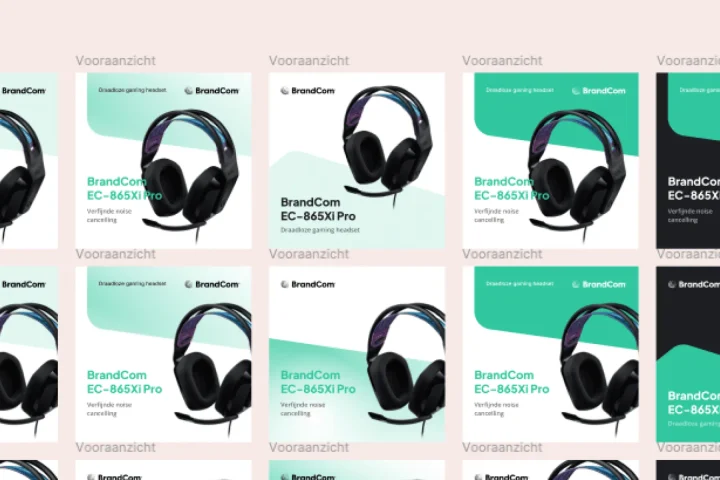
That is why at BrandMonks we build a lot of CRO execution around Figma components and templates. They let you develop variants and product lines faster, with a consistent structure in visuals and arguments.
That scalability prevents two classic growth mistakes: quality differences between listings and lost turnaround time with every new SKU. For teams who want to put this into practice, listing templates and content design are the logical next step.
Common mistakes when increasing marketplace conversion
Mistake 1: steering on revenue only
Revenue without margin and return control gives false success.
Mistake 2: lowering prices too quickly
You buy volume but lose negotiating room and profit.
Mistake 3: no ownership of KPIs
If everyone is responsible, often nobody steps in on time.
Mistake 4: loose edits without test logic
Without a hypothesis and measurement window, you learn very little about what really works.
Mistake 5: treating listing and operations separately
Without a link between content, delivery and return analysis, conversion stays fragile.
Many teams only recognise these mistakes late because each problem seems small on its own. It is the sum that makes the difference. That is why a fixed monthly review of error patterns works better than putting out fires now and then.
Frequently asked questions about marketplace conversion
How quickly do you see the effect of conversion optimisation on marketplaces?
On core listings you often see movement in CTR and order rate within a few weeks, provided you work with clear test cycles.
What is the best first step when performance stagnates?
Start with a funnel diagnosis on impression, click, add-to-cart and return reason. That is how you find the biggest leak.
Should I always improve listing copy first?
Not always, but often. If the first impression and arguments are weak, that slows down almost every step that follows.
Does this work for both Bol and Amazon?
Yes, the logic is similar. The execution differs per platform. For Amazon-specific execution, see amazon listing optimisation.
When does outside help make sense?
When there is not enough internal capacity to keep rhythm, analysis and production at a good level at the same time.
Which KPIs should carry the most weight in the first 30 days?
Start with click rate on core listings, add-to-cart trend and the breakdown of return reasons. That combination shows fastest whether your conversion improvement is commercially healthy too.
Conclusion: increasing marketplace conversion takes a system, not a quick trick
If you want to increase conversion sustainably, you have to master the whole chain: visibility, persuasion, execution and return quality. Then growth becomes something you can steer instead of something that happens by chance.
That is why at BrandMonks we work with a fixed cadence, clear decision rules and scalable content production. That is how you turn data into actions that protect both conversion and margin.
The core is that every team member knows which metric they watch, which threshold triggers action and which correction comes first. Once that structure is in place, managing conversion depends far less on loose opinions and far more on testable decisions.
Want to apply this to your own account? Book an introductory call. We will work out where your biggest lever lies and which 30-60-90 approach delivers the most impact.
Further reading:

Melle Sikma
Helmsman
melle@brandmonks.nl